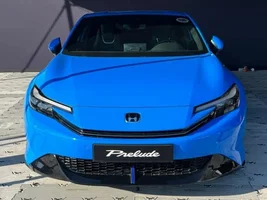
Does the Prelude use the same problematic LF engine that has bad head gaskets?

I haven't had time to worry about my head gasket going since I bought it as I have had a loud platicky squeek / knocking all of the time coming from the back left - passenger side UK. It was sending me mad.
I have spent two weeks looking everywhere - pushing and rocking the car.
Yesterday while having another push and prod behind the passenger seat I leaned on the back of the seat and there it happened.
It only turned out to be the day I bought it I pushed the head restraints right up as I think it looks better.
The passenger seat one was up against the plasticky / rubbery head liner and every time it moved against it, it made that loud annoying noise. Problem solved after two weeks of intense investigation.
How relieved I was and also how annoyed at myself.
They really shouldn't allow wallies like me buy nice new cars.
Well done for tracking this down!

After many years of Honda ownership, I have learned that if the car makes an unexpected noise, it is much more likely to be something that I have done to the car, rather than something that the car has done to me. :)

My last one was a worrying rattle coming from the nearside front suspension on my CR-V. After much investigation it turned out to be a bunch of keys that a passenger had left in the glove box.... 🙄
 
Last edited:
My next and hopefully last connundrum has nearly been solved. Here in UK we have had no rain for 2 months and the first day it rained I thought I was driving through puddles giving me that thump as the water hit the plastic wheel liner on the front left where puddles tend to be on left hand drive roads.
No, I then noticed the passenger side wiper blade got to within 4 inches of its seated position at the base of the windscreen then seemed to stick then sudenly released and banged when it hit its base point. I stopped and cleaned the blade and thoroughly cleaned the glass. I suspect a sticky label was stuck there and the residue was catching the wiper blade.
That improved it significantly but it still looks to stick about an inch up from its seated position when off - so fixed it 75%.
I have used alchohol wipe on glass and blade. Wiped blade with WD40 and other substances but cant get it past that 1 inch up sticking point. Unless it is a point on the glass further along the blade and glass that is sticking and giving the impression the sticking poit is one inch up from the screen base at end of blade. It does look like the end of the blade is being held back a second and then releases.
As an ex toolmaker I will solve it but it is a puzzle - probably easily fixed when figured out.

Mine seems okay, but do let us know if/when you find the answer to this.

Maybe this belongs in the 'issues, repairs, warranty' sub forum - rather than in the epic 'engine failure' one?
 
Honda finally acknowledges there is a problem with their engines and has done the right thing by extending the engine warranty.

 
Last edited:
Like I pointed out -Why isn't the Prelude listed. 26CRV/Civic. Same engine. This is not a bunch of HG or Blocks are faulty which is corrected with a recall. This is Honda admitting there is a design problem and at some point you are going to have an issue. No suggestions on early oil or coolant changes that will help. How does this affect trade in values?
 
Like I pointed out -Why isn't the Prelude listed. 26CRV/Civic. Same engine. This is not a bunch of HG or Blocks are faulty which is corrected with a recall. This is Honda admitting there is a design problem and at some point you are going to have an issue. No suggestions on early oil or coolant changes that will help. How does this affect trade in values?
Honda has a huge brand loyalty and public relations problem on its hands. This is a huge damage control issue for Honda. Im sure Honda's risk management team has calculated what is going to be more cost effective. A recall or something else. A recall where Honda replaces head gaskets and head bolt fasteners might have been an option if defective parts were the actual issue. It is looking like this might be a major design flaw.

It is interesting the Prelude is not listed. It is possible the Prelude is immune from the design issue. I wonder if the Prelude has different head gasket and fastener part numbers? The Prelude engine is manufactured in Japan. Are there are some differences with parts and parts suppliers for engines manufactured in different plants? Is the problem limited to certain VINs?

Honda better get it really right with the next generation drivetrains.

This might not be good for residual and trade-in values.
 
Last edited:
Like I pointed out -Why isn't the Prelude listed. 26CRV/Civic. Same engine. This is not a bunch of HG or Blocks are faulty which is corrected with a recall. This is Honda admitting there is a design problem and at some point you are going to have an issue. No suggestions on early oil or coolant changes that will help. How does this affect trade in values?
Probably going to wait for observed issues before extending the warranty.
 
"The list of covered vehicles is particularly interesting as well, as it includes the standard, non-turbocharged, non-hybrid trims of the 2025-and-newer Civic. Those cars use a K20C9 engine that’s unrelated to the L15 1.5T engine or the LFC hybrid engine, but Honda’s clearly identified a risk here."

The Prelude isn't listed because it's LFC, not K20C9.
I'm sure I read somewhere where somebody had done over 200,000 miles in an HRV hybrid, which is the same engine as the Prelude, with no troubles at all, which makes you wonder if there is a problem, why it has not affected them.
 
I'm sure I read somewhere where somebody had done over 200,000 miles in an HRV with no troubles at all, which makes you wonder if there is a problem, why it has not affected them.
Well if wikipedia is to be trusted the US actually doesn't have any LF* engines in any of its cars since 2022, except perhaps the Odyssey. Whereas most e:HEV cars (specifically those built in Europe, Asia, or Australia) have LF* engines. The HR-V was never sold with an LF* in the states either, instead it uses a K20Z5. All very confusing but it generally seems to suggest it's only really USDM engines that are having the problem.
 
Well if wikipedia is to be trusted the US actually doesn't have any LF* engines in any of its cars since 2022, except perhaps the Odyssey. Whereas most e:HEV cars (specifically those built in Europe, Asia, or Australia) have LF* engines. The HR-V was never sold with an LF* in the states either, instead it uses a K20Z5. All very confusing but it generally seems to suggest it's only really USDM engines that are having the problem.
What does the Civic use in the States then? I understood it was a 2.0L Atkinson-cycle engine, the same as the Prelude.
 
I checked with a Honda parts department to see if the head gasket parts are the same for the Civic and Prelude. They are the same part number. It also looks like the current part replaced an older part with a different part number. I suspect the new part number is an improved part.

I would assume Honda is using the newer head gasket in engines assembled today. Honda should be able to identify which engines are built with what parts by VIN. It is possible the Prelude is assembled with the newer head gasket. That might be the reason why the Prelude is excluded from the recent announcement of extending engine warranties.

It is strange Honda did not isolate certain VINs for the warranty.
 
Last edited:
I checked with a Honda parts department to see if the head gasket parts are the same for the Civic and Prelude. They are the same part number. It also looks like the current part replaced an older part with a different part number. I suspect the new part number is an improved part.

I would assume Honda is using the newer head gasket in engines assembled today. Honda should be able to identify which engines are built with what parts by VIN. It is possible the Prelude is assembled with the newer head gasket. That might be the reason why the Prelude is excluded from the recent announcement of extending engine warranties.

It is strange Honda did not isolate certain VINs for the warranty.
When you say today, do you mean cars made in the last 3 months or so, as I picked mine up in early August, and it was ordered in June? I think they were supplied to order for the UK. It does seem odd that the Prelude is never mentioned in any of the gasket problem articles.
 
The mission has certainly been accomplished: thanks to all the incessant chatter about cylinder head gaskets blowing, the AI has been trained to immediately bombard unsuspecting prospective Prelude buyers with this topic—even though the Prelude is evidently not affected. Just great.
 
So this is some possible interesting findings on the issue you may or may not be aware of...(yes, you can take this with a grain of salt as the info came from Gemini after I drilled it for in depth information)

Here is a summary of the findings regarding the 2026 Honda Prelude's exclusion from the head gasket extended warranty:

The Core Reason for Exclusion
  • Separate Supply Chains: Even though the 2026 Honda Prelude shares the identical 2.0-liter hybrid engine architecture used in the Civic and Accord Hybrids, it uses entirely different parts batches.
  • Geographic Demarcation: Every single vehicle impacted by the Technical Service Bulletin (TSB) is built using components from the North American supply chain network. The Prelude is an import built on an isolated network.

Factory and Assembly Locations

CategoryTSB-Impacted Vehicles2026 Honda Prelude
Engine Manufacturing• Anna Engine Plant (Ohio, USA)
• Alliston Engine Plant (Ontario, Canada)
• Honda Powertrain Facilities (Japan)
Vehicle Assembly• U.S. & Canadian Plants (Ohio, Indiana, Ontario)• Yorii Plant (Saitama, Japan)

Global Scope of the Problem
  • North American Issue Only: The TSB is strictly limited to the United States and Canada due to the specific material variances found in North American factories....It is common for the Anna and Alliston Engine plants to share engine parts between facilities based on supply needs
  • No Global Recalls: There are no worldwide TSBs or actions for this engine issue in Japan, Europe, or other international markets. Higher international fuel standards (preventing engine knock) and tighter Japanese factory tolerances mean the imported Prelude does not share the same real-world risks.
The physical designs of these engines are fundamentally identical, but automotive teardowns, metallurgical analyses, and industry data point to several distinct differences between the North American production line and the Japanese supply chain that triggered the issue.

The primary differences that isolate the head gasket failures to North American engines involve the following factors:

1. Open-Deck Block "Slit" Tolerances and Tooling

Modern Honda Earth Dreams engines feature an "open-deck" block design. Between the cylinder walls, there is a tiny, cooling cooling slit designed to allow coolant to flow directly between the combustion chambers to keep temperatures down.
  • The Variation: Automotive teardown experts have noted that the tooling alignment, precision stamping, and casting molds differ slightly between the Anna Engine Plant (Ohio) and Japanese plants.
  • The Impact: Minor microscopic variations in the width or depth of that cooling slit dramatically weaken the thin strip of metal between cylinders two and three. Under intense thermal expansion, the North American blocks can experience tiny deviations that slowly erode the head gasket material over time.

2. Fastener Tensile Strength and Clamping Torque
To hold an aluminum engine block and cylinder head tightly together, manufacturers use torque-to-yield head bolts.
  • The Variation: Regional supply chains mean the Ohio/Ontario plants source their heavy-duty bolts from North American steel fabricators, whereas Japanese engine factories use domestic component vendors.
  • The Impact: Technicians diagnosing these issues have pointed out that variations in factory clamping force or minor bolt stretch ("tensile strength resilience") under heavy engine loads can cause the head to lift a microscopic fraction of a millimeter. When that happens, hyper-pressurized, superheated combustion gases torch the thin gasket material. The Japanese vendor batches have historically shown higher resistance to this load stretch.

3. Regional Fuel Strains and Detonation (Engine Knock)
North American and Japanese market realities treat identical engines very differently due to local fuel conditions.
  • The U.S. and Canada: The massive majority of Civic, Accord, and CR-V owners fill their cars with standard 87 octane fuel. Under high-heat conditions or aggressive acceleration, low-octane fuel can cause micro-detonation (pre-ignition or "knock"). These are essentially tiny shockwaves inside the cylinder that slam against the head and gasket.
  • Japan: Japanese domestic fuel standards skew much higher, ensuring a higher baseline octane rating at the pump. The lack of fuel-induced micro-detonation prevents the secondary physical hammering that accelerates head gasket degradation.

4. Vehicle Layout and Heat Retention
The North American vehicle lineups include platforms built strictly for the regional market, like the massive Honda Accord or heavy CR-V AWD models. The tightly packaged engine bays of these specific models create "hot spots" right behind the engine block where heat is trapped. The 2026 Prelude, being built on a dedicated, sleek sports-coupe architecture in Japan, benefits from completely redesigned front-end airflow and cooling dynamics that lower thermal strain on the block

 
So this is some possible interesting findings on the issue you may or may not be aware of...(yes, you can take this with a grain of salt as the info came from Gemini after I drilled it for in depth information)

Here is a summary of the findings regarding the 2026 Honda Prelude's exclusion from the head gasket extended warranty:

The Core Reason for Exclusion
  • Separate Supply Chains: Even though the 2026 Honda Prelude shares the identical 2.0-liter hybrid engine architecture used in the Civic and Accord Hybrids, it uses entirely different parts batches.
  • Geographic Demarcation: Every single vehicle impacted by the Technical Service Bulletin (TSB) is built using components from the North American supply chain network. The Prelude is an import built on an isolated network.

Factory and Assembly Locations

CategoryTSB-Impacted Vehicles2026 Honda Prelude
Engine Manufacturing• Anna Engine Plant (Ohio, USA)
• Alliston Engine Plant (Ontario, Canada)
• Honda Powertrain Facilities (Japan)
Vehicle Assembly• U.S. & Canadian Plants (Ohio, Indiana, Ontario)• Yorii Plant (Saitama, Japan)

Global Scope of the Problem
  • North American Issue Only: The TSB is strictly limited to the United States and Canada due to the specific material variances found in North American factories....It is common for the Anna and Alliston Engine plants to share engine parts between facilities based on supply needs
  • No Global Recalls: There are no worldwide TSBs or actions for this engine issue in Japan, Europe, or other international markets. Higher international fuel standards (preventing engine knock) and tighter Japanese factory tolerances mean the imported Prelude does not share the same real-world risks.
The physical designs of these engines are fundamentally identical, but automotive teardowns, metallurgical analyses, and industry data point to several distinct differences between the North American production line and the Japanese supply chain that triggered the issue.

The primary differences that isolate the head gasket failures to North American engines involve the following factors:

1. Open-Deck Block "Slit" Tolerances and Tooling

Modern Honda Earth Dreams engines feature an "open-deck" block design. Between the cylinder walls, there is a tiny, cooling cooling slit designed to allow coolant to flow directly between the combustion chambers to keep temperatures down.
  • The Variation: Automotive teardown experts have noted that the tooling alignment, precision stamping, and casting molds differ slightly between the Anna Engine Plant (Ohio) and Japanese plants.
  • The Impact: Minor microscopic variations in the width or depth of that cooling slit dramatically weaken the thin strip of metal between cylinders two and three. Under intense thermal expansion, the North American blocks can experience tiny deviations that slowly erode the head gasket material over time.

2. Fastener Tensile Strength and Clamping Torque
To hold an aluminum engine block and cylinder head tightly together, manufacturers use torque-to-yield head bolts.
  • The Variation: Regional supply chains mean the Ohio/Ontario plants source their heavy-duty bolts from North American steel fabricators, whereas Japanese engine factories use domestic component vendors.
  • The Impact: Technicians diagnosing these issues have pointed out that variations in factory clamping force or minor bolt stretch ("tensile strength resilience") under heavy engine loads can cause the head to lift a microscopic fraction of a millimeter. When that happens, hyper-pressurized, superheated combustion gases torch the thin gasket material. The Japanese vendor batches have historically shown higher resistance to this load stretch.

3. Regional Fuel Strains and Detonation (Engine Knock)
North American and Japanese market realities treat identical engines very differently due to local fuel conditions.
  • The U.S. and Canada: The massive majority of Civic, Accord, and CR-V owners fill their cars with standard 87 octane fuel. Under high-heat conditions or aggressive acceleration, low-octane fuel can cause micro-detonation (pre-ignition or "knock"). These are essentially tiny shockwaves inside the cylinder that slam against the head and gasket.
  • Japan: Japanese domestic fuel standards skew much higher, ensuring a higher baseline octane rating at the pump. The lack of fuel-induced micro-detonation prevents the secondary physical hammering that accelerates head gasket degradation.

4. Vehicle Layout and Heat Retention
The North American vehicle lineups include platforms built strictly for the regional market, like the massive Honda Accord or heavy CR-V AWD models. The tightly packaged engine bays of these specific models create "hot spots" right behind the engine block where heat is trapped. The 2026 Prelude, being built on a dedicated, sleek sports-coupe architecture in Japan, benefits from completely redesigned front-end airflow and cooling dynamics that lower thermal strain on the block
Does this mean we should really be using 89 or higher octane to prevent knock?
 
In theory the ECU and knock sensor should detect and pull timing before damage is done.
 
Last edited:

Create an account or login to comment

You must be a member in order to leave a comment

Create account

Create an account on our community. It's easy!

Log in

Already have an account? Log in here.

Trending content

Back
Top