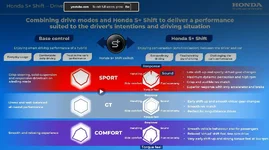
S-plus - Is it really 'fake'

And as a reminder, when considering this stuff, the battery in the Prelude is tiny compared to that in EVs and ‘range extender’ hybrids.
I have a little electric outboard motor with a 1kWh battery. That battery is about the same size and weight as a heavy duty conventional 12v car battery.
 
And as a reminder, when considering this stuff, the battery in the Prelude is tiny compared to that in EVs and ‘range extender’ hybrids.
I have a little electric outboard motor with a 1kWh battery. That battery is about the same size and weight as a heavy duty conventional 12v car battery.

The 1.1 kWh capacity is really the only thing it has in common with a conventional 12 V lead-acid accumulator.

72 lithium ion cells (instead of six lead-acid ones!), 260V, and capable of ultra high charge and discharge rates. It can also deep-cycle without any ill effect, so at least 85% of its theoretical capacity can be used routinely. In the UK, this HV battery is guaranteed to retain at least 70% of its 'as new' capacity for eight years.
 
Last edited:
The 1.1 kWh capacity is really the only thing it has in common with a conventional 12 V lead-acid accumulator.

72 lithium ion cells (instead of six lead-acid ones!), 260V, and capable of ultra high charge and discharge rates. It can also deep-cycle without any ill effect, so at least 85% of its theoretical capacity can be used routinely. In the UK, this HV battery is guaranteed to retain at least 70% of its 'as new' capacity for eight years.
Understood.

What I am really trying to say is that the battery is just a buffer between the ICE+generator and the traction motor.
It’s easy to think of the battery as the source of power and the ICE as there to charge the battery. I certainly saw it that way until I got some miles under my wheels.
But better, perhaps, to think of the ICE+genny as the source of power, with the battery as a buffer that fills in the gaps between traction demand and ICE delivery.

The battery and eCVT makes it possible for the ICE to run in Atkinson cycle, giving almost double the thermal efficiency of a conventional Otto cycle ICE.
 
Understood.

What I am really trying to say is that the battery is just a buffer between the ICE+generator and the traction motor.
It’s easy to think of the battery as the source of power and the ICE as there to charge the battery. I certainly saw it that way until I got some miles under my wheels.
But better, perhaps, to think of the ICE+genny as the source of power, with the battery as a buffer that fills in the gaps between traction demand and ICE delivery.

The battery and eCVT makes it possible for the ICE to run in Atkinson cycle, giving almost double the thermal efficiency of a conventional Otto cycle ICE.
Exactly right. Honda's hybrid system uses the HV battery as a way to temporarily dissociate power demand from power generation - allowing the use of a more efficient (Atkinson) generator, and delivering peak power that exceeds the maximum output of the ICE.

All of the power delivered ultimately comes from the fuel (gas) tank, but ironically the car is electrically propelled most of the time. And most of that electrical energy doesn't pass through the HV battery but is supplied directly to the electric propulsion motor.
 
To put the very modest size of our Prelude's HV battery into context.....
  • 228 kg: the 35.5 kWh 335V lithium-ion battery in my fully-electric (and very small!) Honda e
  • 36 kg: the 1.1 kWh 262V lithium-ion Prelude HV battery
  • 19 kg: a typical 1 kWh 12V lead-acid conventional car battery
The long range battery pack for a Tesla can weigh over 750 kg, so I think the little battery in our 6G Prelude more than 'pulls its weight'! :)
 
Last edited:

Create an account or login to comment

You must be a member in order to leave a comment

Create account

Create an account on our community. It's easy!

Log in

Already have an account? Log in here.

Trending content

Back
Top